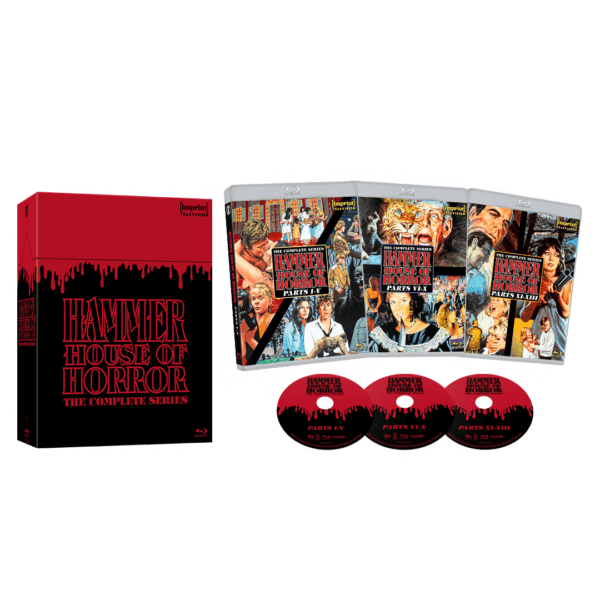
Hammer House of Horror TV Series 1980
Table Of Content
Blood from the Mummy's Tomb was a modern-day take on Bram Stoker's The Jewel of Seven Stars and featured Valerie Leon as a reincarnated Egyptian princess, rather than a mummy. The same novel served as the basis for the 1980 Charlton Heston film, The Awakening, and a later direct-to-video feature, Bram Stoker's Legend of the Mummy, starring Lou Gossett Jr. Production designer Bernard Robinson and cinematographer Jack Asher were instrumental in creating the lavish look of the early Hammer films, usually on a very restricted budget.
Acton, London
The Damned Announce Immersive Hammer Horror Show - Clash Magazine
The Damned Announce Immersive Hammer Horror Show.
Posted: Wed, 26 Jun 2019 07:00:00 GMT [source]
What starts as a seemingly straightforward haunted house narrative soon morphs into something much more impish and playful, and while the scene that gives the episode its name might be the most effective gore moment in the whole series, what comes after is arguably even more fun. My personal favorite Hammer horror film is The Devil Rides Out, which deals with Satanic rituals and occult pandemonium in full Technicolor glory, so I must admit a certain partiality when it comes to the cult episode of Hammer House of Horror. That said, “Guardian of the Abyss,” the story of various parties vying for control of an antique scrying glass that just might be a doorway to a demonic presence, is one of the most classically Hammer tales in the whole series. It’s just a fun, creepy, straight-ahead occult horror story in the grand Hammer tradition, even if it does drag slightly in places. Hammer Horror is deservedly famous for being a place where distinguished English actors could get absolutely bonkers with fun genre stories, and “Rude Awakening” might actually be the best example of that in all of Hammer House of Horror.
The Brides of Dracula
Right from the start, you feel as if you are being played in the most macabre way. Satan and witchcraft occasionally raised their heads, but more often the monsters came from within. In Rude Awakening, the nightmare within a nightmare drives its protagonist to a chilling madness, while the sadistic, bullying weight-loss club at the centre of The Thirteenth Reunion is almost as unpleasant as its final, morbid purpose. The series was released on DVD in the UK (region 2) in October 2002 by ITV Studios.
'Them: The Scare' Season Finale Recap: A Family Affair
It’s both fitting and touching that the best episode of Hammer House of Horror — a series designed to keep the Hammer name alive after its film heyday had passed — is the one led by the studio’s greatest and most devoted star. Both Cushing and Cox turn in powerhouse performances, and Cushing’s clear glee at being able to play a Hammer villain one last time gives the whole piece a sense of real fulfillment. Plus, as a pure horror story, the tension here is more effective than anywhere else in the series. In 1980, Hammer Films created an anthology series for British television, Hammer House of Horror. Shown on ITV, it ran for 13 episodes with a running length of approximately 54 minutes each. In a break from their cinema format, these self-contained episodes featured plot twists which usually saw the protagonists fall into the hands of that episode's horror at the end.
Key horror films
A Field Guide to the Hammer House of Horror Women - Flashbak
A Field Guide to the Hammer House of Horror Women.
Posted: Mon, 11 May 2015 07:00:00 GMT [source]
As the title suggests, this is the werewolf installment of Hammer House of Horror, and though it takes a while to rev up, it does prove to be a fairly satisfying monster story. Yet another example of horrific events colliding with modern British life, the episode follows a couple who find their car breaking down near a mysterious country house, where a kindly woman looks after a large brood of friendly but strange children. You can probably guess their secret just from the title (and the rather effective cold open) but that doesn’t stop the episode from exploding into an effective lycanthropic nightmare by the time it’s all through.
Created by Hammer Films in association with Cinema Arts International and ITC Entertainment, it consists of 13 hour-long episodes, originally broadcast on ITV. One organizer complained that the White House Correspondents’ Association — which represents the hundreds of journalists who cover the president — largely has been silent since the first weeks of the war about the killings of Palestinian journalists. Trump did not attend Saturday’s dinner and never attended the annual banquet as president.

Lawyer Tom Martin (Christopher Cazenove) and his wife Sarah (Celia Gregory) are heading to a country cottage for a holiday when their car breaks down in some remote Somerset woods. There they find a large house, where the housekeeper Mrs Ardoy (Diana Dors) welcomes them and offers them shelter for the night. Mrs Ardoy has many children; she says that some of them are her stepchildren, and some are fostered. All of the children are strange - they sleep at odd times, are afraid of fire, roam the woods in the dark, and become disoriented as dusk approaches. Framed pictures of various women in the house are also seen, apparently the mothers of the various children.

She notes this time that the dead body is that of Martin, but then is shown that the body has decayed teeth while Martin has good teeth. The doctor also tells her about doppelgangers, evil alien beings that take over the entire persona of a human being and become a lookalike but are not the same person; nevertheless, he believes that doppelgangers are only fictional. Penny's mental problems have made her reliant on medication, but Harry rations her dosage.
In less assured hands, the combination of genres might have backfired terribly, but director Alan Gibson shepherds the production through its various tones without ever straining credulity in a way that impedes the entertainment value. 1972, which felt like the franchise running on fumes, Satanic Rites overloads on invention and breathes fresh life into the series. American films of the 70s such as Texas Chainsaw Massacre and Halloween had gone big on the baddie almost getting away with it at the end, but the main characters would always still be saved. In the nasty world of Hammer House of Horror, though, there was no guarantee even of that.
As the plague sweeps the countryside, a quarantined village is visited by a mysterious traveling circus. Soon, young children begin to disappear, and the locals suspect the circus troupe might be hiding a horrifying secret. In 1830, forty years to the day since the last manifestation of their dreaded vampirism, the Karnstein heirs use the blood of an innocent to bring forth the evil that is the beautiful Mircalla - or as she was in 1710, Carmilla.
According to an article in Variety detailing the transaction, the new Hammer Films was to be run by former Liberty Global execs Simon Oakes and Marc Schipper. In addition, Guy East and Nigel Sinclair of L.A.-based Spitfire Pictures are on board to produce two to three horror films or thrillers a year for the U.K.-based studio. The first output under the new owners is Beyond the Rave, a contemporary vampire story which premièred free online, exclusively, on Myspace in April 2008 as a 20 × 4 min. serial. Hammer Film Productions Ltd. is a British film production company based in London. Founded in 1934, the company is best known for a series of Gothic horror and fantasy films made from the mid-1950s until the 1970s.
Seductive vampire Carmilla Karnstein and her family target the beautiful and the rich in a remote area of late eighteenth-century Gemany. After killing his disciple, three English gentlemen unwittingly resurrect Count Dracula, who seeks to avenge his servant by making the trio die by the hands of their own children. After a Monsignor accidentally brings Count Dracula back from the dead while exorcising his castle, the vampire preys on the holy man's beautiful niece and her friends. A man long believed dead returns to the family estate to claim his inheritance.
The company signed a one-year lease and began its 1951 production schedule with Cloudburst. The house, virtually derelict, required substantial work, but it did not have the construction restrictions that had prevented Hammer from customising previous homes. A decision was made to remodel Down Place into a substantial, custom-fitted studio complex[15] that became known as Bray Studios. The expansive grounds were used for much of the later location shooting in Hammer's films and are a key to the 'Hammer look'. After over a decade of directing Hammer interpretations of Dracula, Frankenstein, and the Mummy, Fisher helmed this, his third-to-last feature film and the final that would not have "Frankenstein" in the title. Set in 1929 and based upon the novel of the same name by Dennis Wheatley (published in 1934), The Devil Rides Out stars Lee as Nicholas, a sophisticate investigating the whereabouts of his wayward charge Simon (Patrick Mower).


Comments
Post a Comment